![]() |
| The Dark Side of the Road |
photos © David Greenfield
Visit my web site anytime to view other blog-posts, Galleries of photos, and Photo-essays.
Then kindly share on social media.
![]() |
| The Dark Side of the Road |
photos © David Greenfield
Visit my web site anytime to view other blog-posts, Galleries of photos, and Photo-essays.
Then kindly share on social media.
The number of guns in the US outnumber people. Even if new legislation could halt sale of a single additional weapon, over 400 million handguns and rifles would remain on the street! That’s bad news.
Even worse, these weapons, including millions of assault weapons designed purely to kill during war, would still be accessible to individuals whose inner demons lead them into committing unspeakable crimes.
What to do? Here’s a modest win-win proposal.
Our government should sponsor a generous buy back program. It could be patterned à la Australia’s successful 1996-97 program when close to a million guns were removed from the streets. Those weapons were then destroyed.
Inspired by the words of Isaiah 2: 3-4, 'beating swords into plowshares', most were likely melted down and repurposed into useful tools. We should do the same. But if we already have sufficient 'plowshares and pruning hooks', as a Plan B the guns could be shipped to Ukraine to aid its fight to save democracy and its sovereignty.
In either case, for an outlay just peanuts compared to the billions the Feds are appropriating in aid to Ukraine, this modest proposal would jumpstart transition to a safer American society and could significantly aid Ukraine in its most critical mission and at the country’s most critical hour. Truly a win-win.
We didn't start the fire
It was always burning, since the world's been turning
We didn't start the fire
No, we didn't light it
Billy Joel wrote these song lyrics about a world he saw on fire back in 1989. He was in a recording studio and met a Gen Xer who lamented it was a terrible time to be 21. Joel replied, 'Yeah, I remember when I was 21 and thought that was an awful time. We had Vietnam, drugs, civil rights problems, and everything seemed to be awful.'
All true, the fire started long before.
That was then, and it was bad, but there's certainly no shortage of awful stiff today. In case you've been Rip Van Winkling since '89 and were just awakened, you'd peer above your face mask at a landscape pockmarked by pandemic, a major land war in Europe replete with war crimes & decimated cities, a megalomaniac armed with nukes scheming behind his reimagined Iron Curtain, global climate at the threshold of the ICU, extremism on the rise right and left, racism, democracies and truth on life support, a no longer supreme Court (the lower case 's' is not a typo), inflation, and fears of a worldwide recession, etc., etc., etc. And I haven't even gotten to the obscene, repeated mass slaughter of innocents with guns, lots of guns, military guns, always in the hands of disturbed citizens.
It was always burning
Given the enormity of the conflagration, as well as hindsight that it has always been and will likely go on, and on, and on, it's easy to petrify into inaction, grudgingly accepting the status quo.
There it was, tucked deep in a rear corner of the chest of drawers. How could we have missed it? Hadn’t we just completed the final inspection sweep? The discovery rocked us both back on our heels. It also presented a haunting mystery, one we might never solve, but which nevertheless seemed to contain a message, a message from mom.
In the weeks after our mother was laid to rest, my sister I and spent countless hours in the draining task of shifting through and divvying up all the remaining cherished possessions of our parents’ home. They were collectors, making the task overwhelming at times. At long last we believed we were done, but then there it was - in a dark recess, a delicate, covered china dish. Naturally we expected to find yet another bracelet, pair of earrings, brooch, or pin within.
It was none of the above. Inside were several dark ringlets of hair.
Could it possibly be? No way…. But then again ….
There is a tale in family lore which might hold a clue to the mystery. How I learned about the tale is not clear, but somewhere along the journey I did.
![]() |
| Rachele circa 1946 photo - Joseph Greenfield |
My mother Rachele came of age just after Germany invaded and occupied Poland in 1939. As a young girl during those frightful times, she had long hair, frequently braided and curled in a bun. In her town of Kovel, now part of Ukraine, Jews were regularly being harassed, if not worse. For entertainment troops often enjoyed the spectacle of cutting off beards and hair, the longer, the more beautiful the curls, the greater their sport.
Hearing what Germans were doing, the young Rachele had her parents cut off her locks, denying satisfaction to any soldier feeling the need to humiliate. It was an act of resistance which later led me to consider her a member of “The Greatest Generation”. But her way to fight back was unlike that of the men and women profiled in Tom Brokaw’s best seller by the same name. Those men and women used guns and armor in their battle against fascism then returned home, were celebrated, and hit the reset to start life anew. For my mom, she used only her resolve to battle. Then after years as a refugee, she restarted life in a new country, raising a family and creating an always warm, welcoming balabatish* home. She did it while maintaining a good name and solid friendships all over the globe.
But what about the pitch darkness she endured during the Holocaust** and kept locked within? In the ensuing years that bile would periodically erupt onto the surface. Considering the anguish our family experienced during those lows, and the brittleness of my mother’s final years, it was natural to lose sight of an earlier time. And therein lies a segue to the mystery.
Could it be Rachele’s shorn locks were somehow saved and hidden away, perhaps stored in a delicate china dish? Was she sending a message - “remember me not only by what you struggled through of late. I was once young and strong willed. Remember me also as such.”
I know we will.
* balabatish - Quiet; respectable; well mannered, with a touch of elegance and generosity. From the Yiddish balabusta - an expression describing the perfect homemaker, someone who loves to bring family together by cooking and caring for them.
** Holocaust - The internationally recognized date for Holocaust Remembrance Day corresponds to the 27th day of Nissan on the Hebrew calendar. It marks the anniversary of the Warsaw Ghetto Uprising. In Hebrew, Holocaust Remembrance Day is called Yom HaShoah.
****************************************************************
In fact we should.
With release of Netflix’ film Don’t Look Up, the not looking up meme entered our culture, and unfortunately for some folk, became their mindset. The film is a dark, satirical commentary about climate change and the inevitability of a ginormous, hugantic comet colliding with Planet Earth, destroying all life as we know it. The film hypothesizes how this looming global catastrophe plays out in current national arenas of politics, business, and social media. Spoiler alert! - the tale doesn’t end well for us humans as well as the rest of all earthly flora and fauna. No one lives happily ever after.
So not looking up is really not a healthy modus operandi. In fact, aside from looking down to steer clear of hazardous to your health winter potholes and black ice, looking up is the way to go. Here’s why ……
When one gazes skyward at a boundless expanse of space, the possibilities appear infinite. All options are on the table. The canvas is blank, and therein lies the inspiration which sows seeds of creativity. Those seeds await the right time to germinate to yield new vistas for an enhanced quality of life.
Looking up is also what we do with mentors. There is so much acquired wisdom to be gleaned from those who have been around the block before.
Then there are parents and teachers.
Now getting back to the ‘comet’ of Don’t Look Up …. The film posits a humongous space rock indisputably on track to hit and vaporize Earth. Unfortunately for Don’t Look Up skeptics (and the rest of earthly life), inaction by keeping their heads in the sand and not looking up will soon render them history. But in the real world, we need to look up. That’s key to unlocking the potential of the human mind. That incredible asset, nurtured in part from those who’ve already amassed wisdom of the ages, can unleash a power to achieve the unachievable and bend the arc away from what appears inevitable. Perhaps then the comet, aka the climate change beast, will be tamed.
‘Look down, Look down
Don't look 'em in the eye
Look down, Look down’
sung by Jean Valjean and Inspector Javert - principal characters in Les Miz
To avoid wrath of the law in the teeming, squalid streets of 1832 Paris, Jean Valjean, aka Prisoner 24601, and his fellow convicts made a practice of looking down to avert the eyes of their guards. It was good advice. Casting eyes south happens to be good advice for me now as well for two important reasons, one of health and one of choice. Both merged into sharp focus one frigid New Hampshire Valentine’s Day a decade ago. Here’s what transpired.
The holiday get-away had come to a close and I was packing up the car. Perhaps with two more passes, maybe one if I really loaded up, I felt the task would be finished. Trying to be very efficient I opted for the latter, carrying all remaining bags. So, loaded to the hilt I stepped out for what I was sure would be the final trip. To borrow from Astronaut Neil Armstrong words as he stepped onto the Moonscape in 1969, that one small step for man turned out to be one giant leap into the OR for me. With eyes looking straight ahead I easily missed black ice below. So there I lay, on the floor with bags scattered around, but most having landed on my now shattered right ankle. It would require an orthopedic erector set of screws, plates, and wire to restore function. Ouch! Needless to say, I have been very strategic about where I plant my feet since that fateful day to ensure no reruns of this Valentine’s Day Massacre, especially during winter. That’s health advice I adhere to.
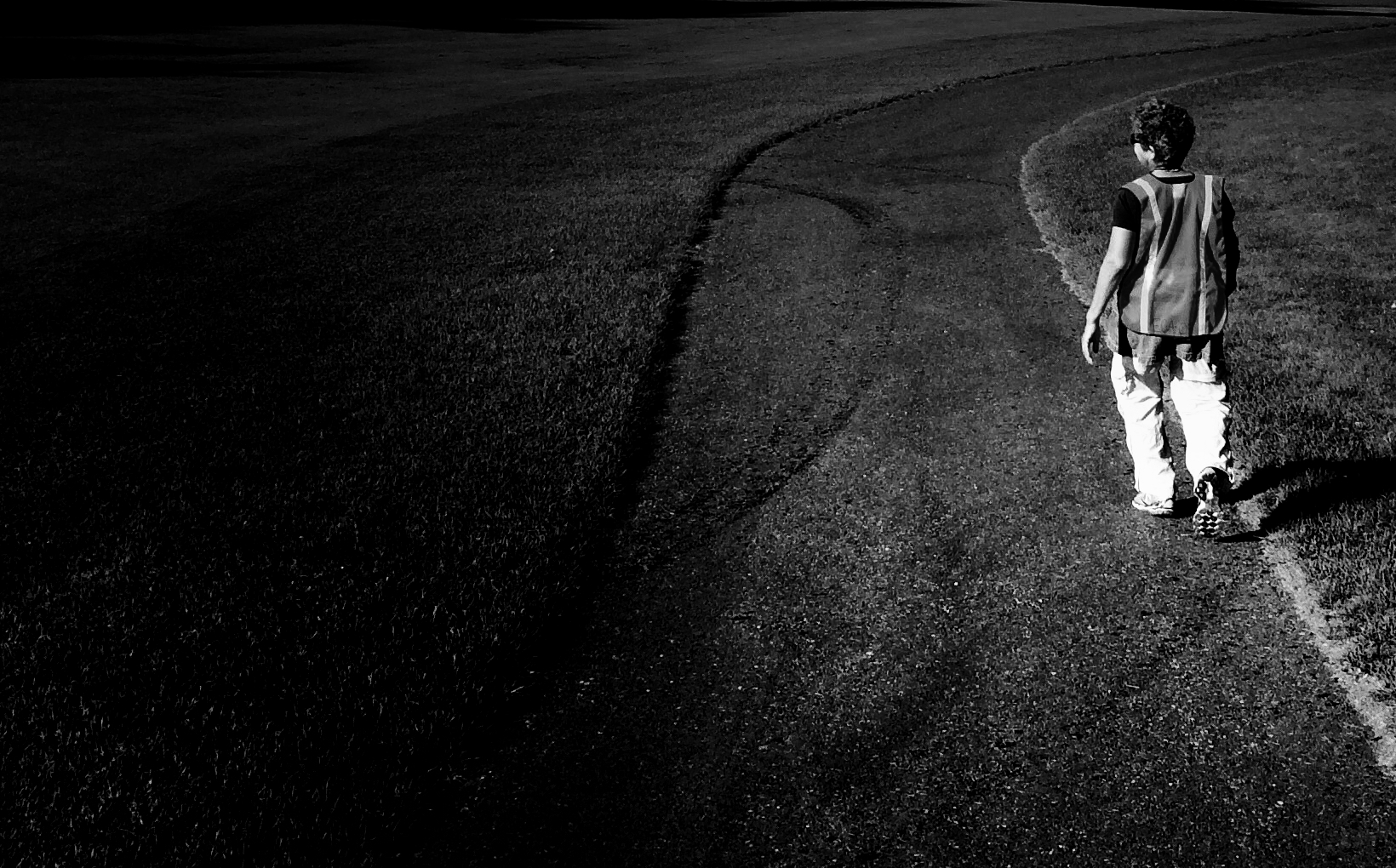
Advice of choice for me lives within the photographic realm. The guideline to follow there starts with using one’s feet when in a compositional search of the optimum perspective. But once there, one should also pause to look behind, upward, and then downward. Sometimes that’s where the image will be found.
Consider this scenario: my wife and I just completed an indoor self guided tour of the Hoover Dam’s inner workings. We then stepped out into a dazzling midday Nevada sun. Although eager to photograph the massive arched behemoth in its jaw-dropping panorama of the desert and Lake Mead, the blinding sunlight forced me to cast my eyes away. That’s where I saw shadows of the stair railings having etched an MC Escher-esque pattern on the sun bleached concrete …. click, I had the shot. Gradually as the rods and cones of my retina recovered from the shock of the indoor-outdoor transition, I was then able to capture other views of my original intent.
Back on the East Coast amidst skyscrapers in the concrete jungle of Manhattan, enough sunlight to illuminate a scene is not a primary photographic concern. Finding an uncluttered background is the challenge. And therein lies another important guideline to follow - with camera in hand, seek a clean background for the main subject. It’s not an easy feat on the chockablock streets of the Big Apple, but looking down can pay dividends. For example, we were out for a stroll with my son and first grandchild, a two something little tot. To fully savor the experience, I took a step back to view the intergenerational family trio. But for complete enjoyment I needed to document the vision. Problem was I couldn’t isolate them from the distractions of all those New Yorkers bustling about.Then I looked down. There it was, the three hand in hand in synchronized step. Click. It’s become one of my most endearing images.
Circling back, looking down helped Jean Valjean in his quest to endure years of captivity. Looking down continues to help me in the quest to avoid winter's pitfalls. It's also important in the continuous quest for capturing the optimum image.
images © David Greenfield
To all my followers I wish you a safe, healthful, and fruitful new year.